Free Online Mulch & Soil Calculator for Precision Gardening

No signups. No costs. Get exact volume counts and retail bag conversions in seconds.

GoToToolbox is a premium, free utility hub built to eliminate guesswork from landscaping and home improvement. Every tool on this platform is engineered on precise volumetric math—not rough estimates. Whether you are laying down a fresh layer of spring mulch, measuring bulk soil for a new raised garden bed, or converting cubic yards to retail bags, our calculators deliver instant, real-world accuracy. No email walls, no paywalls. Just open the tool and get to work.

Our Free Tools

Mulch Calculator

Enter your area and depth — get instant mulch estimates.

Shape
Rectangle
Circle
Triangle
Tip: 2–3 in. for moisture retention  ·  3–4 in. for weed control
Add a bed
No beds added yet.
Tip: Same depth applies to all beds combined.
Results
Bags needed
Bag sizeExact count+10% buffer
Add 10% extra to account for settling and uneven ground.

Raised Bed Soil Calculator

Enter your area & depth and get instant soil counts.

Shape
Rectangle
Circle
Triangle
Tip: 6–8 in. for herbs  ·  10–12 in. for vegetables  ·  18+ in. for deep-rooted crops
Add a bed
No beds added yet.
Tip: Same depth applies to all beds combined.
Results
Bags needed
Bag sizeExact count+10% buffer
Bag counts rounded up — you can't buy half a bag. Weight ~40 lbs per cu ft for typical garden soil.

Why Landscapers & DIYers Use GoToToolbox?

Engineered for real-world projects, built for absolute speed.

Instant Volumetric Results

Input your dimensions and see your results immediately. No processing lags, no ad redirects, and zero delay on mobile devices.

100% Privacy & No Paywalls

We never demand your email or track your personal project data. GoToToolbox is open-access and completely free, always.

Commercial-Grade Formulas

Every calculator uses verified formulas used by professional landscapers and gardeners. You can trust the numbers.

Mastering Your Material Calculation

How Much Do You Need?

When calculating raw materials like organic mulch, topsoil, or compost, precision saves money. Ordering too little results in frustrating second trips to the local nursery or home improvement center, while over-ordering leaves you with massive piles of wasted material on your driveway.

To accurately determine how much mulch or soil you need, you must calculate the total cubic volume of your planting beds. For standard square or rectangular plots, our tools multiply the surface square footage by your desired depth in feet. However, home landscapes often contain complex geometric variations. That is why GoToToolbox features advanced modules to seamlessly handle calculations for circular garden rings, triangular borders, and multi-bed residential projects.
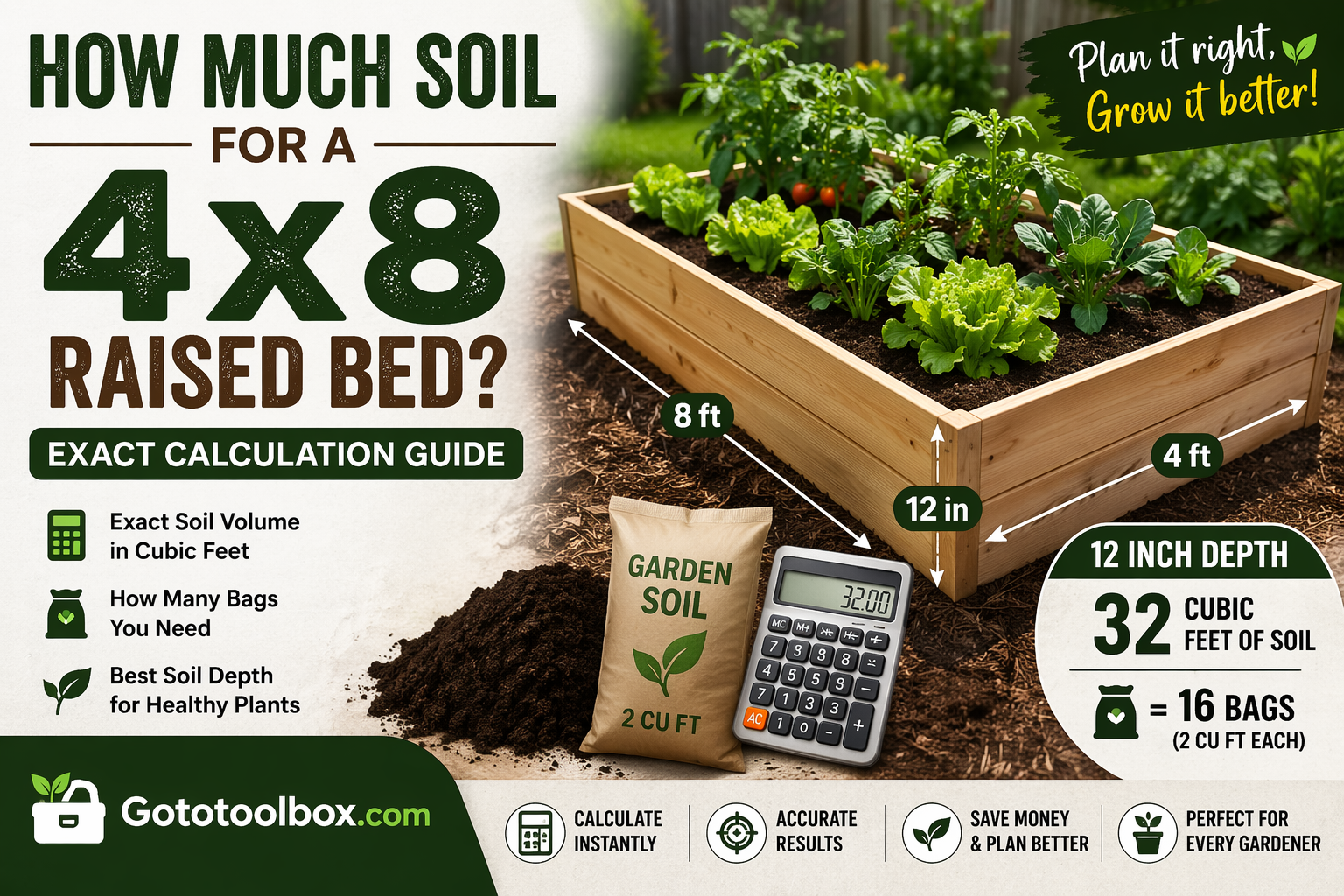
How much soil for 4x8 raised bed

About GoToToolbox

Accurate Material Estimation Tools Designed for Simplicity

GoToToolbox was engineered to solve a common problem: most online calculators are bogged down by sluggish loading speeds, or locked behind mandatory signup forms. We believe planning your next project should be frictionless.

Our specialized suite focuses strictly on premium landscaping calculations, giving you precise metrics for structural garden layouts. From converting complex geometric patterns into exact cubic yards to breaking down volume metrics into straightforward store-bought retail bag counts, our tools do the heavy lifting. Whether you are prepping a raised garden bed layout with optimized topsoil or planning your annual spring mulch coverage to block out stubborn weeds, GoToToolbox brings field-tested math right to your screen.

No hidden fees, no data harvesting. Just instant, reliable, real-world numbers to keep your projects on budget and completely optimized.

🌱 New tools are coming soon — bookmark GoToToolbox.com so you don’t miss them.

Free Online Calculators & Garden Tools Built for Accuracy, Gototoolbox

FAQs - Frequently Asked Questions

How do you calculate how much mulch is needed for a flower bed?

Landscaping mulch volume is calculated using three simple dimensional variables: length, width, and depth. The basic mathematical formula for standard rectangular beds is:Length (ft) * Width (ft) * (Depth (inches) / 12) = Total Cubic FeetTo convert this value into commercial bulk units, use this formula:Total Cubic Feet / 27 = Total Cubic YardsThis tells you the exact number of cubic yards required for bulk delivery.


How many bags of mulch equal one cubic yard?

Standard retail bags of wood chips or shredded bark typically hold 2 cubic feet of material. Because one cubic yard contains exactly 27 cubic feet, you will need exactly 13.5 bags of a 2 cu. ft. capacity size to equal a single bulk cubic yard. The simple formula is:27 / Bag Size (cu. ft.) = Total Bags NeededIf you are purchasing larger 3 cubic feet bags, you will need exactly 9 bags per cubic yard.

What formula does the Circle Mulch Calculator use?

To find the coverage volume of a circular garden ring or around an isolated landscape tree, our calculator utilizes the geometric area formula for a circle multiplied by depth: Area = π × r² (where r represents the radius, or half of the total diameter across the bed). This square footage is then multiplied by your target insulation depth (e.g., 3 inches) to reveal the exact structural volume.

How much soil do I need for a standard 4x8 raised bed?

A standard 4x8 raised garden bed has a surface footprint of 32 square feet (4 feet * 8 feet = 32 sq. ft.). The amount of soil required depends directly on your bed's height:For a 6-inch deep raised bed: 16 Cubic Feet (approx. 0.6 Cubic Yards)For a 12-inch deep raised bed: 32 Cubic Feet (approx. 1.2 Cubic Yards)If you are buying standard 1.5 cu. ft. bags of garden soil from stores like Lowe's or Home Depot to fill a 12-inch deep bed, the math is:32 Cubic Feet / 1.5 cu. ft. Bag Size = 21.3 Bags (Round up to 22 bags to completely fill the plot).

Is it cheaper to buy bulk mulch or bagged mulch?

For small garden projects under 2 cubic yards, buying individual bags at retail stores like Lowe's or Home Depot is usually more practical and cost-effective. However, for larger landscaping projects, purchasing bulk mulch by the cubic yard from a local supplier is significantly cheaper per square foot, even when factoring in a flat commercial delivery fee. Use our calculator to determine your exact volume needs before choosing your purchasing method.

How do you calculate mulch for a triangular garden bed?

To find the required material volume for a triangular landscape plot, you must first calculate its surface area by multiplying the base width by the total height length, then dividing that number by 2:Base (ft) * Height (ft) / 2 = Total Square FootageOnce you have the square footage, multiply it by your preferred depth layer to establish the total cubic volume:Square Footage * (Depth (inches) / 12) = Total Cubic FeetOur advanced calculation tools handle this multi-step geometry automatically so you can avoid manual estimation errors.